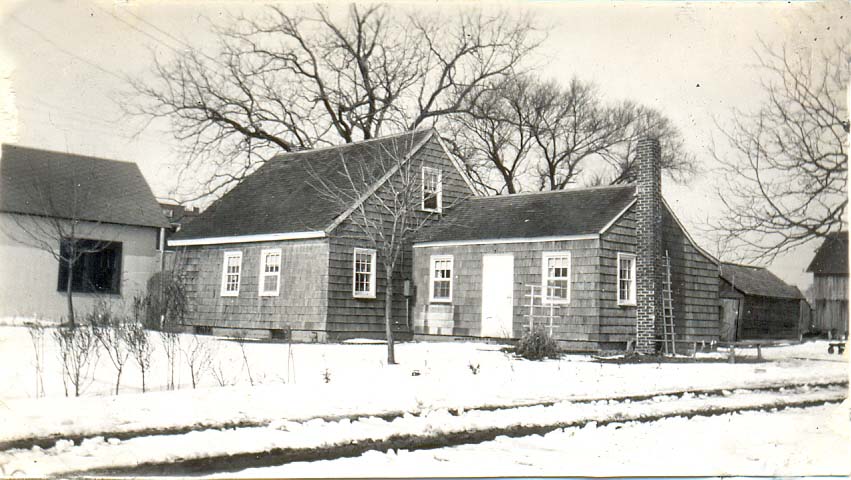
The Wells Tuttle House, built 1775
At the left in the above photograph is shown part of the Tydol service station added to the original Tydol gasoline station by Bart Brown. A small section of the Eastport High School appears between the roofs of the service station and the house. At the right and to the rear of the house is a small "woodshead" and a two-story barn. The large tree behind the house is a black walnut, and the two small trees in the front yard are maples. This picture was probably taken about 1947. The original house had an appendage on its left side, which was moved to the rear of the main house when the house was moved about 20 feet to the north, away from Montauk Highway, so that the two section automobile service station could be added. At that time the house was moved over a new basement.
HISTORY OF THE TWO TUTTLE HOMESTEADS IN EASTPORT
The first mention of a house in the Speonk-Eastport area was in 1693.[1] The meadows at Speonk were laid out in 1712 and were used for summer and fall cattle pasture.[2] Just before the Revolution "Hunter" John Tuttle (1728-1805), who lived in Speonk with four sons, bought of Edward and Sarah Petty seven lots comprising all of Seatuck Neck bounded on the west by Seatuck River, north by Old Country Road, on the east by East Creek and pond and south by the bay. The Petty's had received this land as a grant from the king of England. The date of this transaction is reported to be 1775.[3]
Eventually this land between the East Pond and the West Pond was divided between John's third and fourth sons John (1756-1814) and Daniel (1758 [or 1761]-1845 [or 1856]). John owned from the East Pond to the gulch which has its origin north of Main Street, and which formed the eastern property line of the late Dorothy Raynor, runs past "Raynor's Hill" and the hill in back of Everit Pettins' house, then arcs around and drains into the cove south of the West Pond. The area between this gulch and the West Pond belonged to the fourth son Daniel.
Between 1720 and 1740 a house was built on the North Shore of Long Island. This house was carefully marked and disassembled and brought by wagons from its original location to "Hunter" John Tuttle's land on the north[4] side of Montauk Highway and the west side of Bay Avenue. The house was then carefully reassembled using marks in Roman numerals and arrows carved in the hand hewn beams.[5] This has sometimes been called the "Cephas Tuttle" house, Cephas (1808-1891) being a grandson of John and his wife Sarah Wells. At some point this house was no longer lived in and was sold to William Moses Edwards (1863-1958), grandfather of Mervin A. Tillinghast (1909-1998).[6] Mr. Edwards ("Willie Mode") is a descendant of John Tuttle, and this is possibly how the transaction came about.
Edwards was going to move the house to the west side of Eastport where he lived, near the house of Dr. Benjamin F. Rogers. Things were done more slowly in those days, using horses to pull the house. When the house got down about as far as Lakeview Court, a little past where Ralphie Tuttle used to live, it began to get dark and Edwards decided to park the house overnight, and resume the move the next day. While they were doing this, "Pickie" Pickford Robinson, who lived in the big white house on the south side of the street, came out to see what was going on, and said he would give Edwards fifty dollars for it. Edwards said "It's yours." So instead of leaving the house in the street he moved it around and in back of Pickford's, and for several years Pickford used it as a paint shop. ("Pickie" was a house painter). Later a widow bought both it, the front house, and the rest of the buildings on the property, and restored the house. She and her second husband, a person by the name of Helms, live in it. The house is situated at 457 Main Street, on the south side of Montauk Highway and south of the third house west of River Avenue, (345 feet west of River Avenue).[7]
The "oldest" house actually built in Eastport (see above photograph) was known as the "Wells Tuthill" house, Wells (1808-1887) being the third son of Daniel Tuthill (1758-1845) and Sarah Parshall. This house was located on the north side of Montauk Highway, and was originally the first house to the west of the Methodist Church (later variously known as the Bible Protestant Church of Eastport, Eastport Gospel Church, and Eastport Bible Church). This house was constructed by "Hunter" John Tuttle for his son Daniel the same year he bought the land from the Pettys.[8]
Some of the descendants of "Hunter" John Tuthill born in this house were:
Wells Tuthill (1803-1887)
Jonathan Vail Tuttle (1842-1927)
Carrie Wesley Tuttle (1870-1945)
Bartlett Vail Tuttle Brown (1911-1976)
Robert Louis Brown (b. 1934)
Janet Frances Brown (b. 1937)
The 1930 Federal Census shows Irving Brown, his wife Rose Hudak Brown, and son Irving J. Brown [Joe], living in the house, which they rented for $15 per month. In February 1927 Irving & Rose's daughter Dorothy was killed by an automobile which went off the road in front of the house.
This house was located quite close to Montauk Highway, which, at the time, was merely a path for horses. With the advent of automobiles the road was widened and this left only a small front yard. Bartlett T. Brown had acquired the house from his parents and had purchased a small Tydol gasoline station located at the corner of Montauk Highway and Tuttle Avenue. The gas station was next to the Wells Tuttle house. In 1939 trenches[9] were dug to allow the house to be moved approximately 30 feet north, away from Montauk Highway, onto a new foundation. At the same time, an appendage on the westerly side of the house, (a bedroom), was detached and reattached on the north side of the house. This permitted a new two-bay automobile service center to be constructed on the east side of the original gas station.
In the late 1930's and 1940's the house had a kitchen, large pantry, back foyer with an ice box, dining room, living room, bath, and two bedrooms on the first floor. The doorway between the dining room and living room was only 5' 8" tall, indicating the shorter stature of people in the late 1700's. This short doorway resulted in many bumped heads by subsequent taller occupants. On the second floor was a bedroom and two attic spaces. On the second floor a small second bedroom with a twin bed was added by Bart Brown, and the flooring was nailed in place by Josephine [Lawrence] Brown. Whenever the Long Island Railroad steam engine would go past the house, about a quarter mile away, the upstairs furniture would always shake as if a minor earthquake were taking place. The cellar occupied the entire space beneath the living room, bathroom and the first back bedroom. This cellar had a hot air coal furnace, a coal bin, an electric water pump, and a ping-pong table [eventually used as a model railroad table]. Visible in the basement were the old hand hewn [walnut?] beams, with tree bark still on them.[10]
At one time, probably in the early 1940s this house had a sign on the front lawn near the driveway stating "Built in 1775."[11]
The house and automobile service center were deeded to Bart Brown's wife Josephine (Lawrence). Josephine. Her three children, Richard Vail (b. 1931), Robert Louis (b. 1934), and Jonathan Dan (b. 1941) lived in the house until they left home. Josephine's second husband Paul Erwin lived in the house from 1952 until a boating accident claimed his life in December 1959. Erwin made several modifications to the interior of the house, and added a large bay window in the south facing living room that changed the external appearance of the once historical house. The modifications also created a major instability on the second floor and a carpenter had to be called in to correct the problem.
The garage had been rented to Arthur "Bubbie" Williams for several years. Eventually, the well water derived from the driven well point became contaminated with gasoline and the leaking underground gasoline tanks had to be dug up and replaced. (There were no EPA regulations in those days).
In 1959 the house was sold outside the family to Stanley and Grace Durst. When this account was originally written (1996) the exterior of the house appeared to be in good condition but the entire front lawn of this historic house had unfortunately become a "used car lot." Presently, the automobiles have been removed and the house has been rented to a number of tenants. The current address of the Wells Tuthill house is 388 Main Street, Eastport, NY.
[1] History of Eastport, L.I., N.Y. 1775 - 1975 and Eastport Gospel Church 1822 - 1975 by LeRoy Wilcox, p8.
[2] Ibid, p8
[3] As verbally related by Ruby Brown on 2 Feb 1959.
[4] The Southampton Town "Area Study" says "southwestern corner of North Bay Avenue, near Montauk Highway.
[5] Southampton Town Eastport/Speonk/Remsenburg/Westhamption Area Study, p. III-9, III-11
[6] As told by Mervin A. Tillinghast, September 1996
[7] Ibid, Mervin A. Tillinghast
[8] Ibid, Ruby Brown
[9] The Brown children had lots of fun playing in these trenches
[10] As recalled by Robert L. Brown
[11] Richard V. Brown had a large framed picture of the house showing the "1775" sign near Montauk Highway